



Antonio Canova: The Renowned Italian Sculptor
Antonio Canova was a leading Italian sculptor of the neoclassical period, famed for his idealised marble works that were inspired by ancient art. Born on 1 November 1757 in the Venetian Republic town of Possagno, Canova grew up largely in the care of his paternal grandfather Pasino, a stonemason who nurtured the young boy’s precocious talent from an early age.
As a teenager, Canova was apprenticed for two years to prominent sculptor Giuseppe Bernardi, known as Torretti, before undertaking academic studies and opening his first studio. Canova gained widespread recognition for his early works, commissioned by a Venetian senator, including statues of Eurydice (1773-1775), Orpheus (1775-1776), and Daedalus and Icarus (1779), all of which are in the collection of Museo Correr in Venice.
Canova’s Stellar Career in Rome
At the age of 22, Canova travelled to Rome where he studied neoclassical sculpture as well as ancient Roman and Greek art. In 1781, he established a workshop in the Eternal City and received patronage and support from the Rezzonico family of Pope Clement XIII and from Venetian ambassador Girolamo Zulian. Canova won acclaim for his monument to Pope Clement XIV unveiled in the Basilica dei SS. Apostoli in 1787, and his tomb for Pope Clement XIII installed in St Peter’s in 1792.
Psyche Revived by Cupid’s Kiss
Canova’s international fame was sealed in 1793 with Psyche Revived by Cupid’s Kiss (Amore e Psiche) commissioned by Colonel John Campbell and today in the collection of the Louvre in Paris (a second version is in the State Hermitage Museum in St Petersburg).
Collaborations and Commissions
In 1796, Canova undertook the monumental marble sculpture of Hercules and Lichas completed only in 1815, and now in the collection of the Galleria Nazionale d’Arte Moderna in the Italian capital. When French troops arrived in Rome in 1798, Canova returned to Possagno where he devoted himself to painting and travels in Europe.
He returned to Rome two years later and in 1802 he met Napoleon in Paris and received a commission to create a monumental statue of the First Consul. This was the start of a series of works portraying members of the Bonaparte family, most famously the sublime sculpture of Napoleon’s sister Pauline Bonaparte as Venus Victrix (1808), today a star attraction of Galleria Borghese.
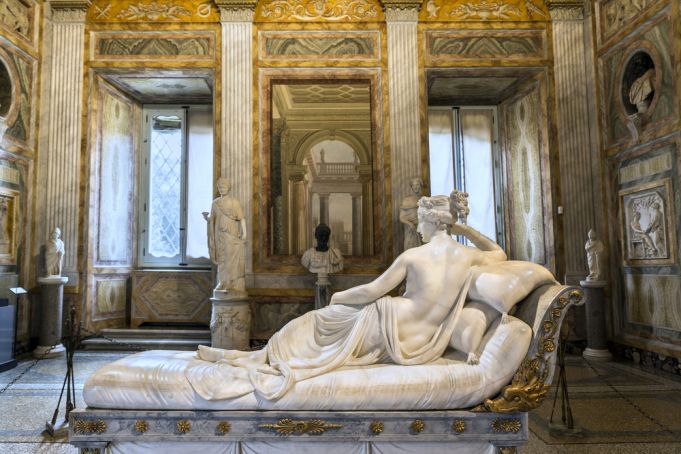
Pauline Bonaparte as Venus Victrix
Later Life and Legacy
In 1815, Pope Pius VII appointed Canova as chief delegate to the Congress of Paris, a mission that proved successful in repatriating numerous precious artworks looted from Italy during Napoleon’s ascendancy. Canova was celebrated worldwide for The Three Graces after an English collector commissioned a second version of the original created for Napoleon’s first wife Joséphine de Beauharnais (now in the Hermitage in St Petersburg).
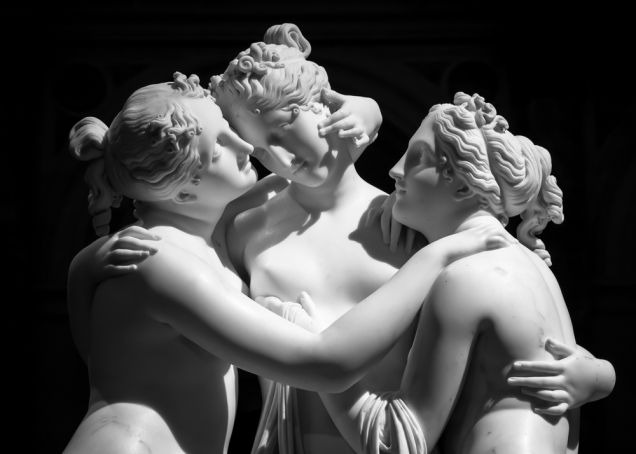
The Three Graces (detail)
Today, Possagno hosts the Canovian Gypsotheca which preserves the heritage of the artist and houses a treasure trove of his works. Meanwhile, those in Rome – in addition to visiting Canova’s masterpieces around the city – can call into Caffé Canova Tadolini on Via del Babuino, the former studio of Canova and later his apprentice Adamo Tadolini, and enjoy a coffee surrounded by sculptures and casts by both artists.
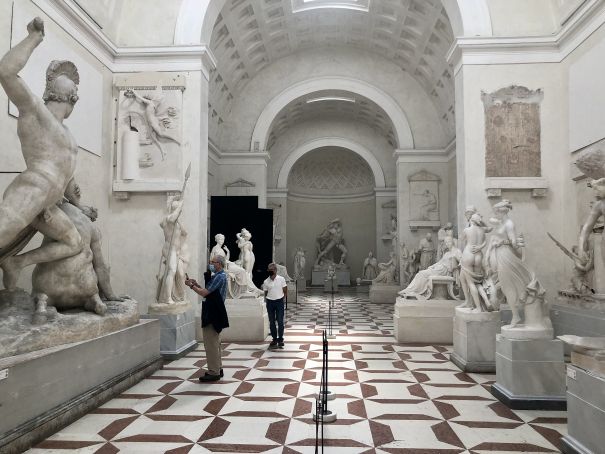
Gipsoteca Canoviana
Cover image: Pauline Borghese as Venux Victrix in Galleria Borghese. Photo credit: Vasilii L / Shutterstock.com. For more information on Antonio Canova, Here